
Vibration
3-axis sensing with eight calculated values.

For international shipping, please visit
You’re Browsing from a Different Region
Orders from this site will only ship to European Countries.
For international shipping, please visit IoTMart Global.
Connect industrial assets with versatile wireless connectivity.
From wireless I/O and smart sensors to industrial access points and gateways, Advantech helps collect field data reliably and connect it with OT, IT, and cloud systems.
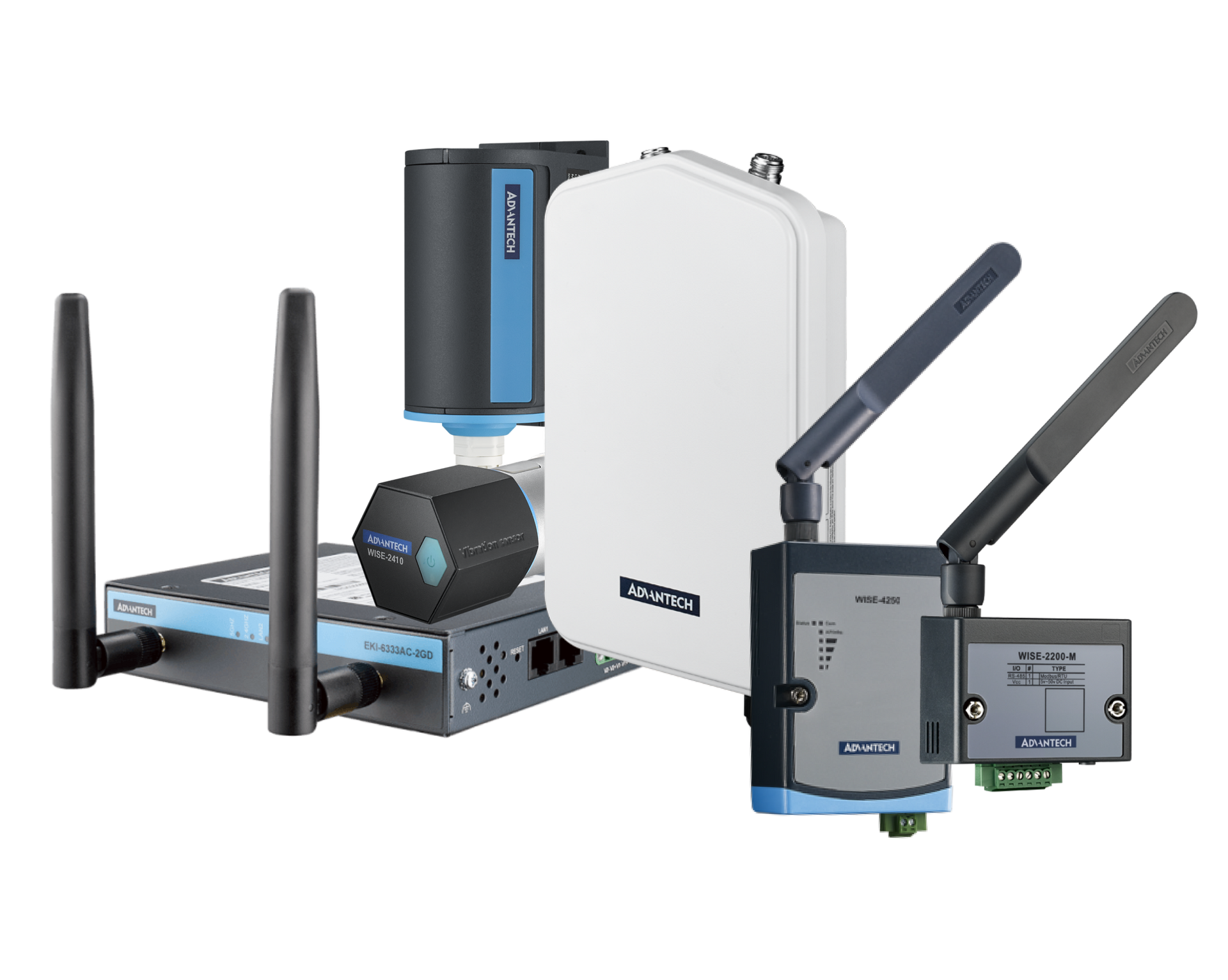
Use high-throughput Wi-Fi for local industrial networks or long-range, low-power Sub-G connectivity for distributed and hard-to-wire assets.



110 m, up to 1167 Mbps
a/b/g/n/ac, 2.4/5 GHz
5 km line-of-sight
863–928 MHz, SF7–SF12
2 km line-of-sight
625 bps–50 kbps, 868/923 MHz
Operator coverage
3GPP Rel. 13, Cat. NB1/M1
Monitor vibration, temperature, humidity, current, water leakage, and machine status with ready-to-deploy wireless sensors and I/O.
3-axis sensing with eight calculated values.
Ambient or probe sensing from −70°C to 200°C.
Temperature and humidity sensing up to 90% RH.
Three-phase clamp-on current measurement.
Water-line detection with alarm output.
DI and RS-485 machine-state acquisition.
Connect field data with SCADA, MES, cloud, and partner platforms through widely used industrial protocols. Selected LoRaWAN gateways integrate with third-party network servers such as The Things Network and ChirpStack, as well as AWS IoT Core, with built-in MQTT, Modbus/TCP, and Node-RED.
*EdgeLink (-EL) models only.


Map each function to your acquisition, monitoring, connectivity and scaling needs before SKU comparison.
Wi-Fi I/O modules bring analog, digital, relay, and serial signals onto existing plant networks.
Industrial access points, clients, and device servers connect mobile assets and legacy equipment.
LoRaWAN sensors capture vibration, temperature, humidity, current, and water leakage across hard-to-wire sites.
Industrial LoRaWAN gateways connect field nodes with local OT systems, partner network servers, and cloud platforms.
Evaluate field constraints through our guided architecture selector, or filter technical specifications directly across our portfolio.
Evaluate optimal wireless hardware across range, signal density, and field conditions in 4 guided steps.
6DI + 1× RS-485, dry and wet contact input.
4DI + 4 relay, 2.4 GHz — the cost-down switching node.
Dual-band 2T2R AP / Client / Bridged Repeater, DIN rail.
1-port RS-232/422/485 to 802.11 WLAN device server.
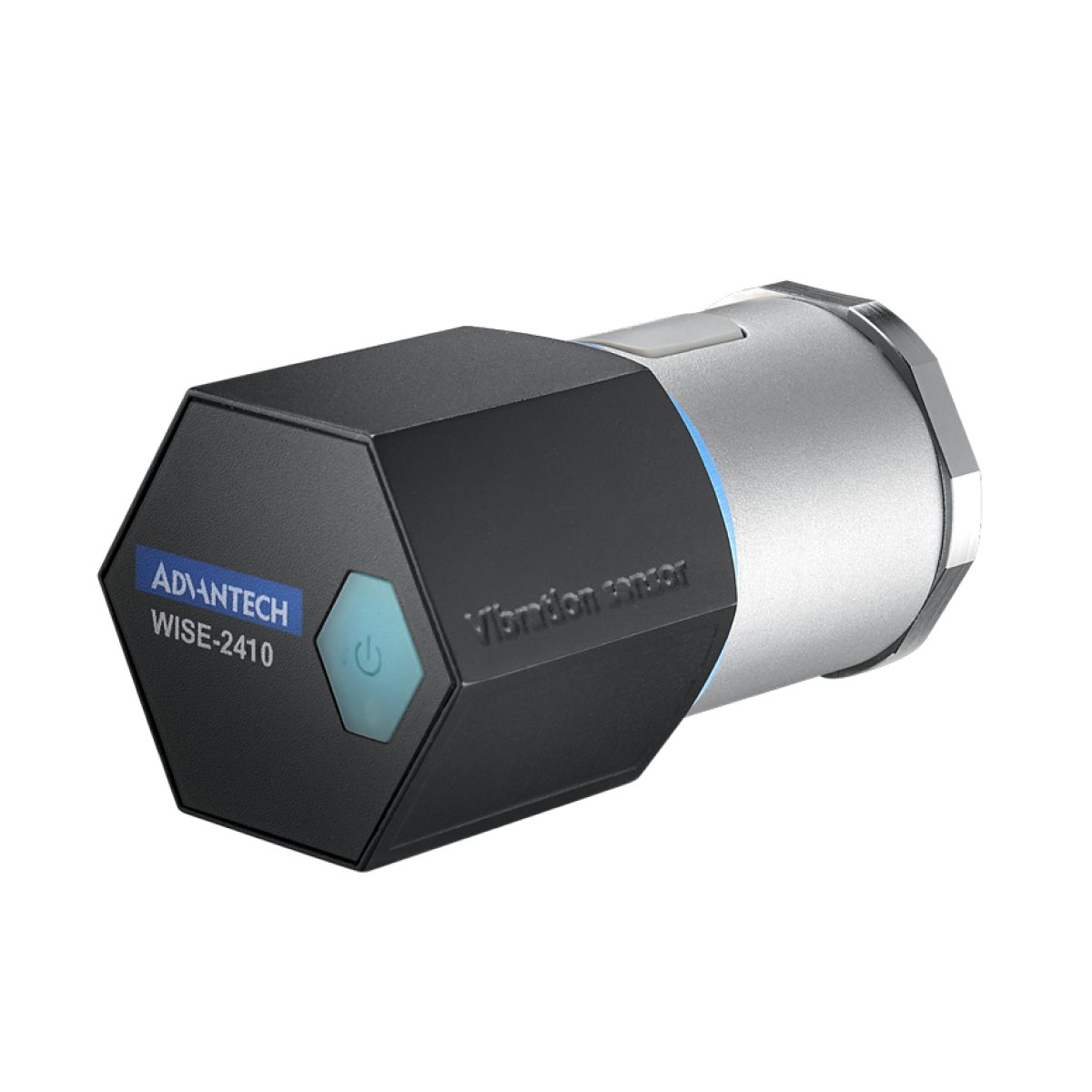
3-axis vibration + temperature, eight values computed on board.
Ambient temperature and humidity, QR-code setup.
3-phase current, 3 × 75 A clamp-on CT.
Water leakage detection to a 3.5 mm water line.
SX1302 gateway, embedded LoRaWAN network server, Node-RED.
Outdoor modular LoRaWAN I/O, solar rechargeable or 10–50 VDC.
NB-IoT / LTE-M modular I/O, solar rechargeable, GNSS.
Proprietary sub-G modular I/O, up to 5 km range.
Self-powered 3-channel CT node — powered by the CT.
No products match this combination.

WISE-2410MeshedX LoRaWAN
WISE-2200-MWISE-6610PNode-RED
EKI-1361EKI-6333AC-2G802.11r
WISE-2410XWISE-4610PWISE-S617-AWISE-6610PSelection depends on transmission distance, power availability, and network ownership models. Industrial Wi-Fi excels in plant-floor environments where high sampling throughput and direct MQTT/RESTful publishing over DC power are required. Private LoRaWAN delivers long-range, battery-powered telemetry across sprawling facilities without recurring carrier fees. Proprietary Sub-GHz offers a lightweight, energy-harvesting solution for targeted point-to-point links. For geographically dispersed assets across multiple sites, Cellular (NB-IoT/LTE-M) connects directly to public operator networks, eliminating on-site gateway infrastructure.
Yes. WISE-6610 can use its embedded LoRaWAN network server, supporting up to 500 nodes, or operate in gateway mode and forward packets to a compatible external LNS. Depending on the installed software and configuration, external LNS options may include Actility ThingPark, ChirpStack, and The Things Network. Verify the required forwarding interface and upstream platform before finalizing the intended regional deployment architecture.
Selected WISE-4000 Wi-Fi I/O modules support RTC-stamped local data logging for up to 10,000 samples. This capability can help preserve readings during temporary network interruptions, subject to the model, logging settings, and network configuration. Do not assume the same buffering and recovery behavior for LoRaWAN or other wireless nodes; verify the selected model before deployment.
LoRaWAN and sub-GHz frequency plans, product suffixes, and certifications vary by model and destination market. Before ordering, verify the exact part number, supported frequency band, and current local regulatory approvals in the product datasheet and with your Advantech representative. A suffix used for one product family should not be assumed to have the same meaning across the entire portfolio.
Yes. The WISE-2210 is a self-powered Sub-GHz current-monitoring node that harvests operating power through connected current transformers, eliminating batteries and separate power wiring. It sends three-channel current measurements through a WISE-4210 access point. Confirm current product availability, compatible CT specifications, regional frequency, and the required access-point architecture with your Advantech representative before specifying it for a project.
Yes. WISE-6610 can support local LoRaWAN deployments using its embedded network server, Node-RED workflows, MQTT, and Modbus/TCP. WISE-6610 models equipped with EdgeLink add integration options such as BACnet/IP and OPC UA. Final connectivity to an isolated OT network, DCS, or SCADA system depends on the selected model and system configuration.
Published line-of-sight (LoS) ranges represent ideal conditions; industrial indoor environments with dense steel structures, concrete barriers, and high EMI require realistic propagation planning. Advantech recommends conducting an initial on-site RF survey and deploying dual-gateway redundancy in mission-critical facilities. Overlapping gateway coverage provides automatic spatial diversity (multicast/ADR), mitigates multipath fading, and prevents single-point-of-failure risks.
Regional spectrum rules can affect channel plans, transmit power, payload sizes, reporting intervals, and supported LoRaWAN settings. Requirements vary by frequency plan and destination market, so confirm current local regulations with the applicable authority or a qualified local specialist. Then configure the channel plan, payload size, reporting interval, and spreading factor for the approved product and operating region.
The WISE-2410 performs onboard edge computing, calculating 8 statistical feature parameters (including RMS velocity, peak acceleration, displacement, and kurtosis) aligned with ISO 10816/20816 vibration severity standards for rotating machinery (>600 RPM). While ISO zones provide standardized baseline severity classes based on machine scale and mounting stiffness, users can define customized multi-tier warning/alarm thresholds and dynamic anomaly triggers suited to specific equipment baselines.
The full product-line catalog, selection guide, spec tables and six case studies.
Download PDF →Discuss field parameters, networking topology, and power constraints with an industrial IoT specialist.
Contact us →
Explore real-world deployments, learn when 6 GHz capacity and Multi-Link Operation add practical value, and review what to validate before upgrading.
Download the Case Study Guide